Psalms

Proverbs 16:9

In his heart a man plans his course, but the Lord determines his steps.

Psalm 4:4
Stand in awe; commune with your own heart, and be still.


Thursday, May 4, 2017

Callaway Gardens

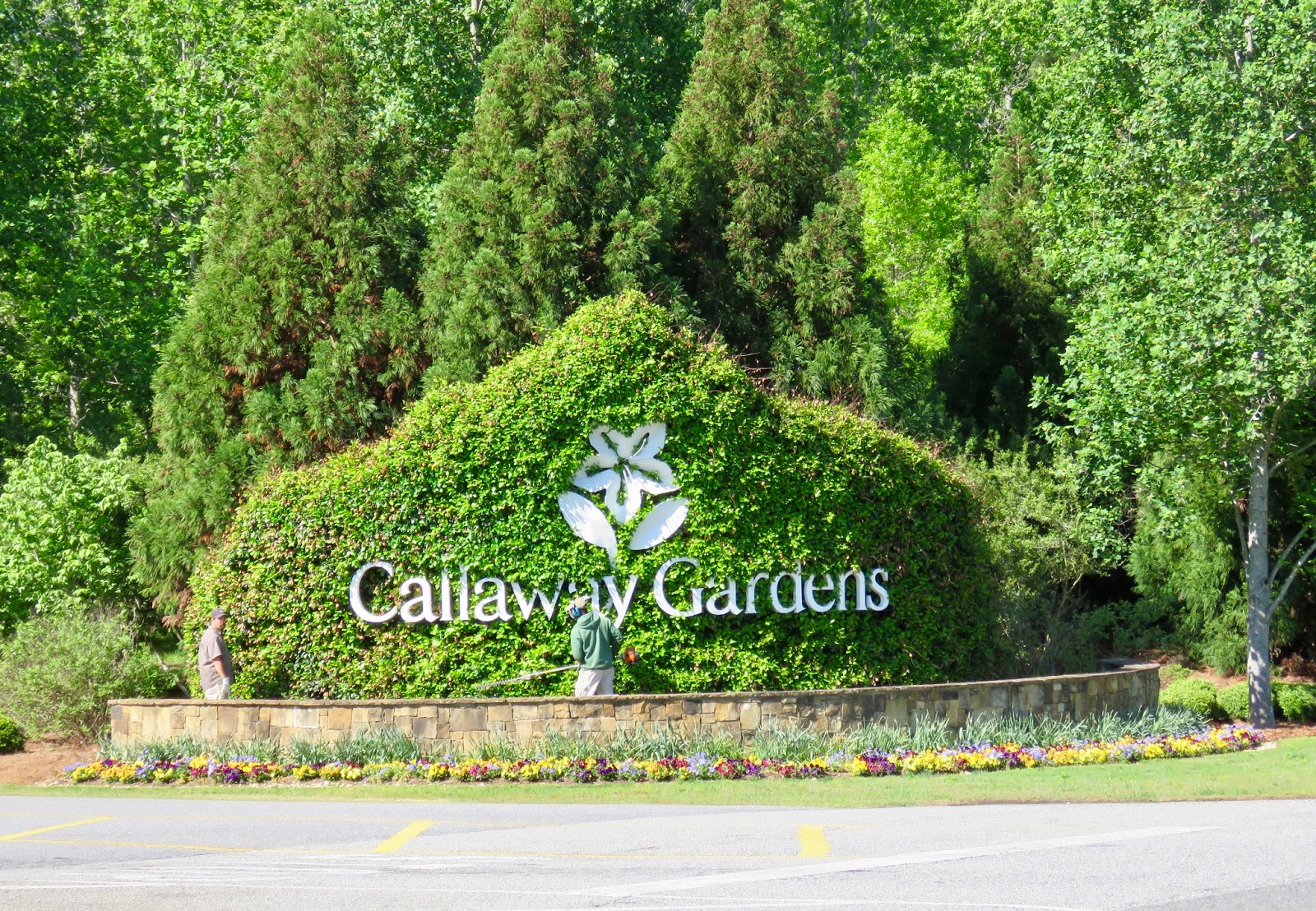
The entrance to Callaway Gardens in Pine Mountain, GA. Conceived and founded by Cason and Virginia Callaway, this 2,500-acre garden opened to the public in 1952 as a retreat where "man and nature could abide together for the good of both."
Designed for year-round beauty, the azaleas take center stage in early Spring, but were past their peak when RVing friend, Brenda and I arrived.
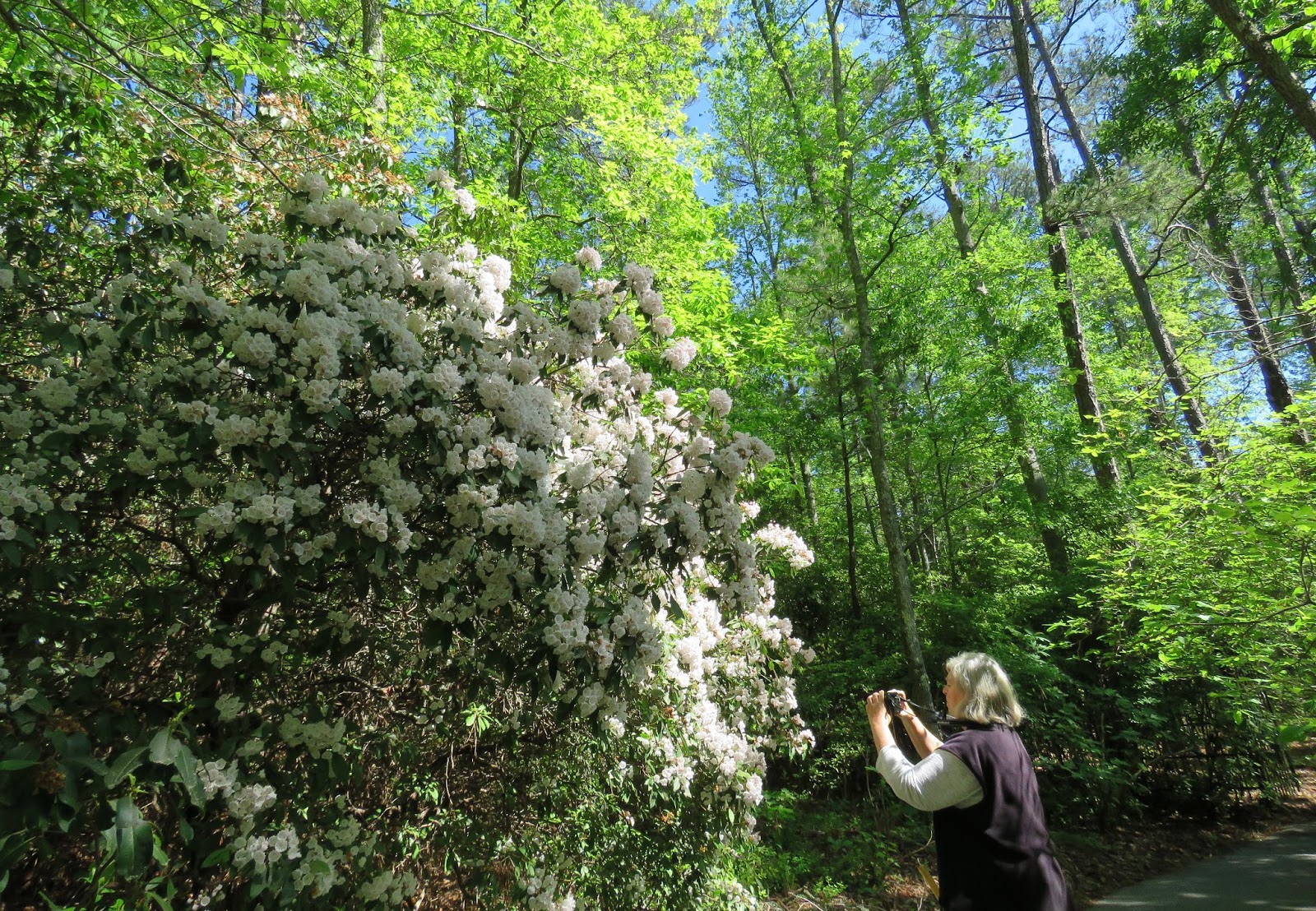
But one can't be disappointed because the Mountain Laurel were blooming in full splendor.
The Callaways made their fortune in the textile industry. When Cason Callaway retired as CEO, he and his wife turned their attention on creating these gardens. This area is known as the "Azalea Bowl," and was funded by one of the Callaway brothers.
Although the azaleas blossoms are gone by, mountain laurel and irises line the pond.
Brenda on the bridge over the azalea bowl.
More Mountain Laurel
We'll see a lot more butterflies later in the Butterfly Garden.
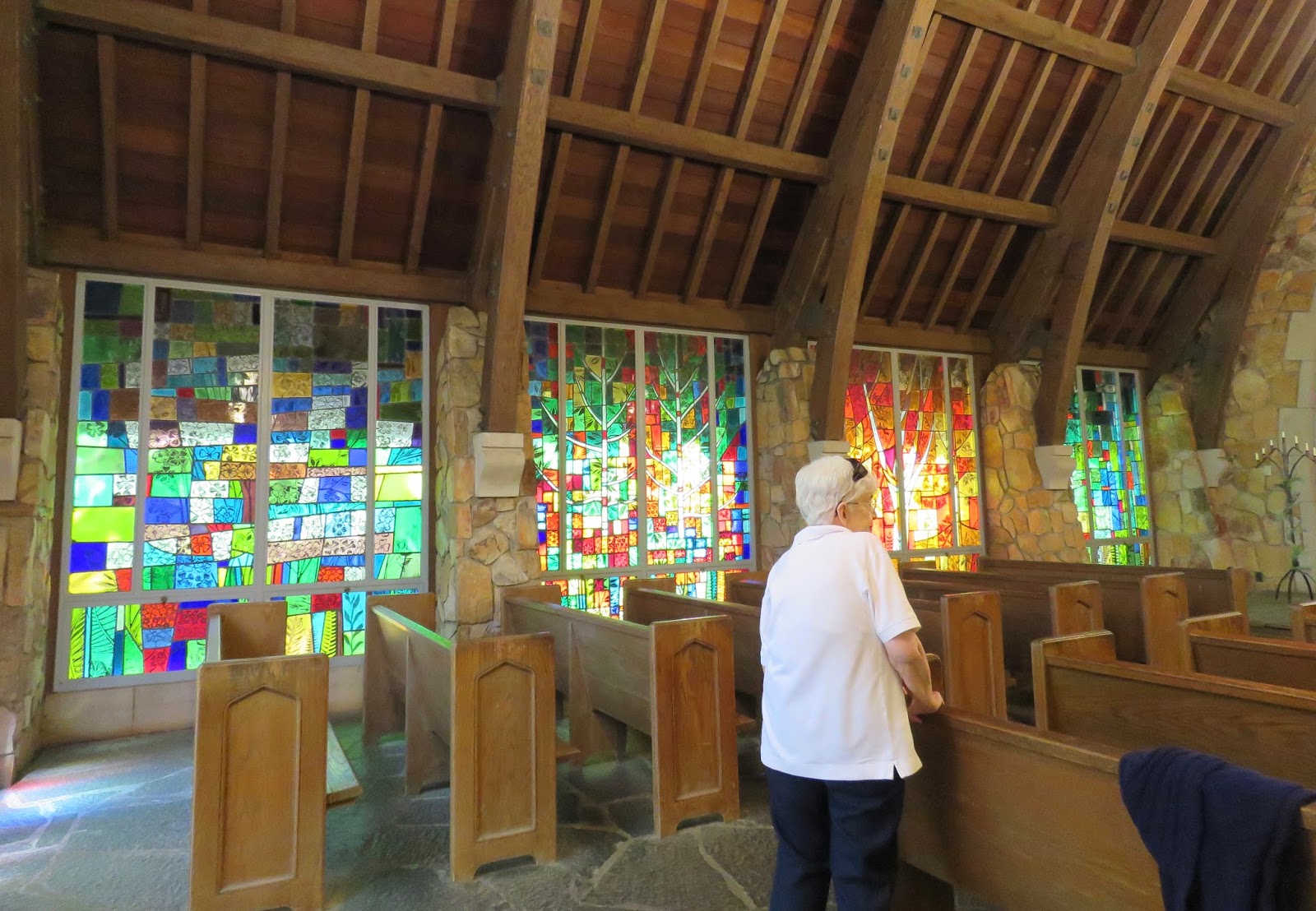
Cason had a chapel built in honor of his mother, Ida Cason Callaway. You can tell where he got his name.
Behind the chapel is a small waterfall and creek. The location was chosen so that the creek could be dammed below creating a small lake in front of the chapel.
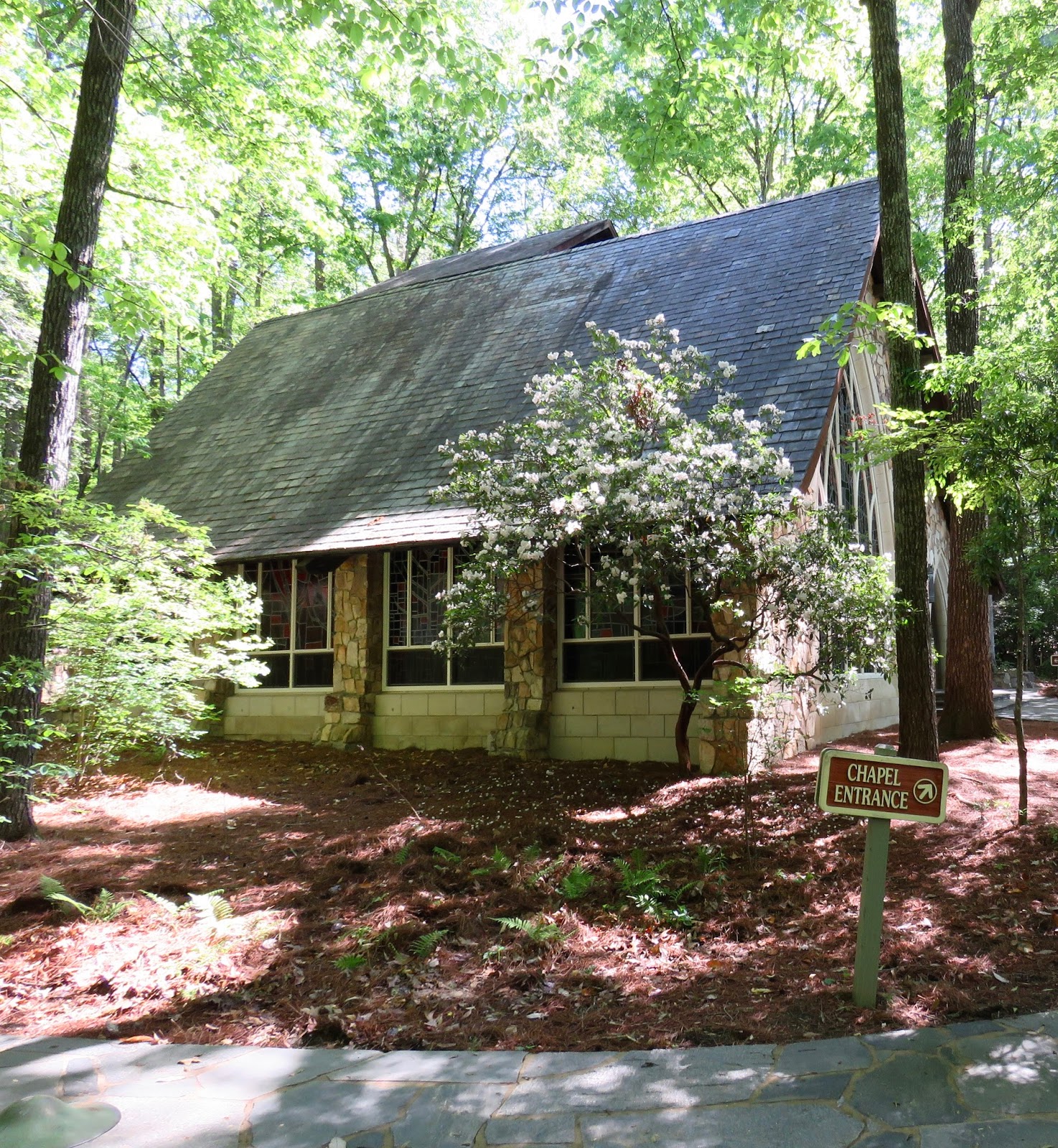
The little chapel in the woods is used for many weddings.
This stained glass window represents Georgia pines, and all varieties of native GA pines are represented in the glass panes.
The side windows represent the four seasons.
And the other large window represents oak trees.
Lower Falls Creek Lake
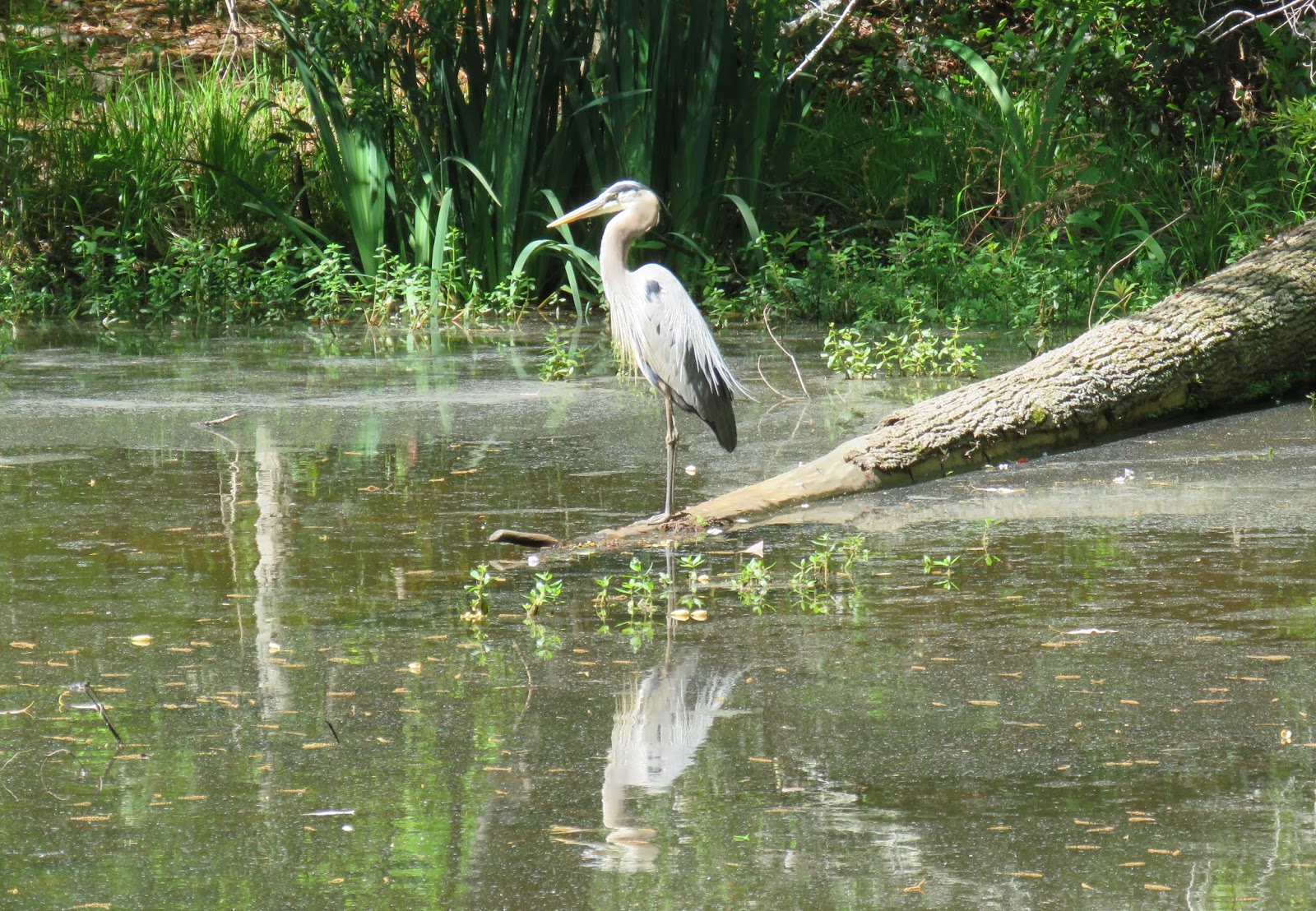
A Great Blue Heron stands guard.
Cason Callaway died a year before the chapel was completed. It was dedicated in 1962 by Dr. Norman Vincent Peale.

Native plumleaf azaleas.

Bridge across the Azalea Bowl.
This little wildflower is called "Fringed Pink."
The Camelias were gone by too, but I found this one bloom.
We had lunch at the cafe here.
Visitors were feeding turtles below the bridge.
Well-fed turtles.
Lunch made us late for the raptor show. We got there just in time for the clean-up crew...a Black Vulture.
He may not be very pretty, but he has an important job to do.
Along the scenic drive we found some azaleas still in full bloom.
Pretty Azaleas
A family of geese in one of the many ponds.
Our last stop was the Butterfly Garden. Doesn't Brenda make a pretty butterfly?
Entrance to the Butterfly Center.
Before we enter the butterfly enclosure, there is an active display of chrysalis. Each one is labeled above.
This huge Atlas Moth just emerged from its chrysalis. It has a wingspan of 10-12 inches.
The butterfly enclosure is very warm and humid, just as the butterflies like it. We, not so much.
Tropical gardens...

Sometimes the butterflies hide under a leaf.
Feature Plant, a genus of Bromeliad.
Notice the lovely blue topside, and the camouflage underside of the wings.
Brenda with a butterfly on her head.
You didn't expect me to remember all the names, did you?
It's a jungle in there.
Butterflies doing what they do...
There are multi-levels in the butterfly enclosure.
More wildflowers in the fields as we were leaving.
Looking down on Callaway Gardens from a Pine Mountain overlook.

Saturday, April 29, 2017

FDR's Little White House

This was my first visit to Warm Springs, GA and to President Franklin D. Roosevelt's "Little White House. It was a very interesting tour, and I learned a lot about that period of history.
The entrance buildings house a museum and gift shop.
Inside the museum is a life-size model of FDR in a wheelchair. 
His paralysis was caused by polio which he contracted in 1922 at about 40 years of age. He first came to Warm Springs in hopes of finding a cure in the warm mineral water. Not many pictures show FDR in a wheelchair or appearing to be handicapped in any way. He was always able to exude power, charisma, and confidence to those around him.
This display was twice as big as the photo shows and shows all the various carved canes he received as gifts. 
FDR's 1938 Ford was custom made for him with hand controls at the Georgia prison factory. This was the last car he drove at Warm Springs. 
Although the springs did not bring the cure he hoped for, the exercise did relax and tone his muscles. He created a foundation to bring other polio victims here for the therapeutic benefits. 
About the treatment Center at Warm Springs. 
The circa 1800 stagecoach, "Tally-Ho" was acquired by FDR when he purchased the Meriwether Inn Resort to establish his treatment center for polio patients. It was used by Foundation staff and patients in parades in Warm Springs through the years.
FDR became president at the height of the Great Depression. He communicated his plans and confidence for recovery in a series of Fireside Chats via radio. Many of these were recorded at the Little White House in Warm Springs.
  One of FDR's New Deal agencies was based on his getting to know his Georgia neighbors, and observing the need for electricity in rural farms.
 The Japanese bombing of Pearl Harbor brought us into World War II, and another crisis in FDR's presidency. His leadership also brought the country together and lifted us out of the Depression.
These small Bibles with a personal message from FDR were handed out to soldiers going to war. 
The Little White House is also where FDR died after suffering a stroke while sitting for a portrait. The unfinished portrait is on display here as well as a later portrait that the artist finished to show what she thought it would have looked like had he lived.
Walking toward the Little White House. The two buildings in the foreground are a guest house on the left and servant's quarters on the right with a garage underneath.
My RVing friend, Brenda, in front of the Little White House.
A plaque outside. 
We enter through the kitchen. This icebox was kept on the small porch outside the kitchen.
The pantry. Notice the note written beside the doorframe at left. FDR's cook wrote that note in pencil (above the white sign) on the day FDR died. It has been preserved like the rest of the house as it appeared that day. 
 There's a roll of paper towels above the sink, hanging from a coat hanger.

 The note.
Wishbones hanging on the kitchen wall have been preserved as well.
The dish cupboard.
The living room chair where FDR sat for his portrait. It is where he collapsed from a cerebral hemorrhage. 

The other side of the room was the dining area. Notice the easel on the right. 


You pass through the Legacy building on your way out. It is where the Unfinished Portrait is now on display.
FDR's last day. 
The "Finished Portrait" was painted to honor the 25th anniversary of FDR's death.
FDR was carried to the adjoining bedroom after his collapse. He later died in this bed.

Notice that FDR died at 3:35 Central War Time. "In 1942, at the height of World War II, President Franklin D. Roosevelt instituted year-round Daylight Saving Time in the United States. Referred to as “War Time”, DST was in force continuously from February 9, 1942 to September 30, 1945.
During this time, the US time zones were called “Eastern War Time”, “Mountain War Time”, “Central War Time”, and “Pacific War Time”. After the surrender of Japan in mid-August 1945, the time zones were relabeled “Peace Time”."
Notes FDR made to a speech he was working on his last day. Still good advice today.
The Pine Mountain Valley Project was one of FDR's effort to resettle city welfare recipients back to the country where they could become self sufficient again. I like that it was not a gift/welfare, but a loan to be repaid.
My campground (FDR State Park) was on Pine Mountain. It was one of FDR's favorite getaway spots when he was in Georgia.
He was instrumental in having the road built over the mountain and picnic areas built.
Dowdell's Knob was one of FDR's favorite spots.
He would drive up here and have his staff remove one of the car seats for him to sit on. 
This was his view of the valley. I'm sure it is here that he conceived his resettlement plan. 
Some of the farm houses built as part of that plan are still lived in today. 
I was honored to sit beside him and admire the same view he enjoyed.